K
The Book of Five RingsKyushu is the setting of the opening scene of Miyamoto Musashi’s The Book of Five Rings, where Mount Iwato anchors the author’s account of writing and prayer. The island is also part of the book’s larger conceptual geography: the work moves through five books, from Ground to Void, and presents strategy as a Way understood through practice, nature, and disciplined perception.
Setting and Composition
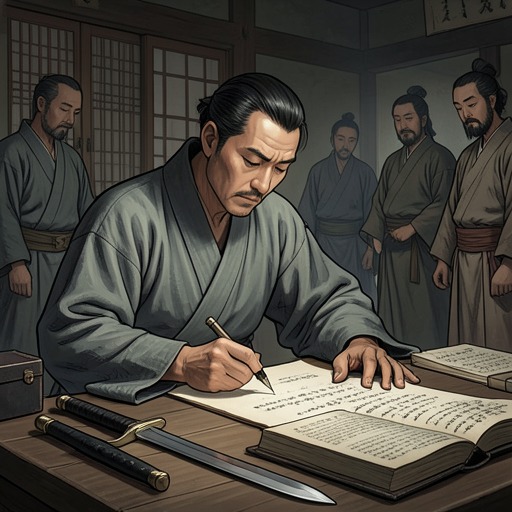
In the first ten days of the tenth month of 1645, Musashi says he climbed Mount Iwato in Kyushu. He identifies himself there as a sixty-year-old warrior of Harima Province and describes the act of composition as taking place in a setting marked by prayer: he pays homage to heaven, prays to Kwannon, and kneels before Buddha. The location therefore enters the book not as a battlefield or a scene of combat, but as the place from which Musashi introduces his life’s study of strategy and begins to explain it in writing.
Musashi dates the writing to the night of the tenth day of the tenth month, at the hour of the tiger, which he gives as three to five in the morning. The exact time and the stated acts of devotion make the opening unusually situated: the book’s account of strategic knowledge begins with a named mountain, a specific region, a date, and a writer who presents himself in prayer. The text does not explain the relationship between this opening date and the later date attached to its closing section.
A Spiritual and Strategic Frame
The opening joins the physical act of writing to a broader account of how Musashi understands his authority. He says that he spent years training in the Way of Strategy, called Niten Ichi-ryū, and that he now intends to explain it in writing for the first time. He recounts beginning to study strategy in youth, reconsidering his victories at thirty, and searching morning and evening for its principles before saying that he realized the Way at fifty. Kyushu is thus the stated setting for a book written after a lifetime of practice and reflection.
The book’s structure extends this framing beyond the opening. Its five books are Ground, Water, Fire, Wind, and Void: Ground lays out the path, Water treats the spirit and methods of victory, Wind examines other schools, and Void concerns what has no beginning or end. Musashi describes the Way of strategy as the Way of nature, in which the strategist recognizes the rhythm of a situation and acts naturally. The association of Kyushu with the opening of this work places the act of explanation at a threshold between lived experience and a system intended to be studied.
From the Opening to the Void
The book’s closing treatment of the Void clarifies the conceptual destination of the structure introduced at the beginning. Musashi distinguishes the true Void from mere bewilderment: not understanding something does not make it Void. Rather, knowing what exists makes it possible to know what does not exist. He concludes that wisdom, principle, and the Way have existence, while spirit is nothingness. This account is not presented as a description of Kyushu; it is the work’s final philosophical subject, set in relation to the opening scene of prayer and composition.
The closing section bears the date of the twelfth day of the fifth month in the second year of Shōhō, 1645, and is signed by Terao Magonojo and Shinmen Musashi. The book therefore gives two distinct dated frames: Musashi’s account of writing at Mount Iwato in Kyushu in the tenth month, and the later-dated closing passage on the Void. Kyushu’s significance is grounded in the first of these: it is the named place where Musashi presents the work’s composition as the culmination of long training, while the book’s final pages articulate the principle toward which its five-part design has been moving.